Most Honda Civic owners check tire pressure only when the TPMS light comes on. By that point, the tire is already noticeably underinflated. A few minutes with a gauge once a month can prevent uneven wear, poor fuel economy, and — in worst cases — a blowout.
This guide covers everything you need to know: the right PSI for your specific Civic trim, how to measure it correctly, what “cold” actually means, and how to reset your TPMS after adjusting pressure.
Where to Find the Correct Tire Pressure for Your Honda Civic
Before anything else: do not use the number printed on the tire sidewall as your daily target pressure. That number is the maximum the tire can physically handle — not what Honda recommends for your car.
The correct tire pressure for any Honda Civic is printed on the Tire and Loading Information Placard, located on the driver’s side door jamb. Open the driver’s door and look at the edge of the door frame. The sticker lists recommended cold PSI for both the front and rear tires, specific to your vehicle’s trim, load rating, and factory tire size.
That sticker is your only authoritative source. Everything else is secondary.
Typical Tire Pressure Range for Honda Civic
Most Honda Civic models — including the LX, EX, Sport, Sedan, and Hatchback — fall within a 30 to 35 PSI cold pressure range. Honda often uses slightly different front and rear specifications to account for weight distribution.
Here’s how that typically breaks down:
Standard trims (LX, EX, Sport, Sedan, Hatchback):
- Front: 33 PSI
- Rear: 32 PSI
Performance trims (Civic Si, Type R):
- Front: 35 PSI
- Rear: 33 PSI
These numbers reflect recent model years. Older Civic generations may differ slightly, which is another reason the door placard should always be your first reference — not a chart from the internet, including this one.
| Source | PSI Value | What It Means |
|---|---|---|
| Driver’s Door Placard | 30–35 PSI (varies by trim) | Honda’s optimized pressure for safety, handling, and wear |
| Tire Sidewall | 44–51 PSI (max) | Maximum the tire can hold — not a target for daily driving |
| Compact Spare (Donut) | 60 PSI | Required for temporary-use spare tires only |
What “Cold” Tire Pressure Actually Means
When Honda says 33 PSI, they mean 33 PSI measured in a cold tire. This distinction matters more than most drivers realize.
Air is a gas. As tires roll on the road, friction heats the air inside, which causes pressure to rise. If you check your tire pressure right after a highway drive, you might read 36 or 37 PSI — which looks fine, but isn’t an accurate reflection of the actual inflation level once the tires cool.
A tire is considered “cold” when:
- The vehicle has not been driven for at least three hours, or
- It has been driven less than 1 mile (1.6 km) since sitting idle for three or more hours
For most people, the best time to check pressure is first thing in the morning, before driving anywhere. That gives you the most accurate reading and the best opportunity to correct it before the day’s driving begins.
How Temperature Affects Tire Pressure
For every 10°F drop in ambient temperature, tire pressure falls by approximately 1 to 2 PSI. This is predictable physics — cooler air contracts, reducing the internal pressure of the tire.
This is why the TPMS light commonly appears on the first cold morning of autumn or winter. The tires haven’t developed a leak; the air inside simply contracted overnight. You’ll need to add air to bring the pressure back up to the placard value.
Tires also lose about 1 PSI per month naturally through normal permeation — air slowly works its way through the rubber and past the rim seal. Combined with seasonal temperature drops, this means monthly pressure checks aren’t optional if you want consistent performance and tire longevity.
Waiting for the TPMS light before checking pressure isn’t a maintenance strategy. By the time the light triggers, the tire may already be significantly underinflated.
The Sidewall Max PSI: A Common and Dangerous Mistake
This deserves its own section because it’s a widespread problem.
The large number molded into the tire sidewall — often something like 44 PSI or 51 PSI — is the maximum pressure the tire can structurally withstand, not the recommended operating pressure. Inflating your Civic’s tires to that number is a safety error with real consequences.
What happens when you over-inflate to sidewall max PSI:
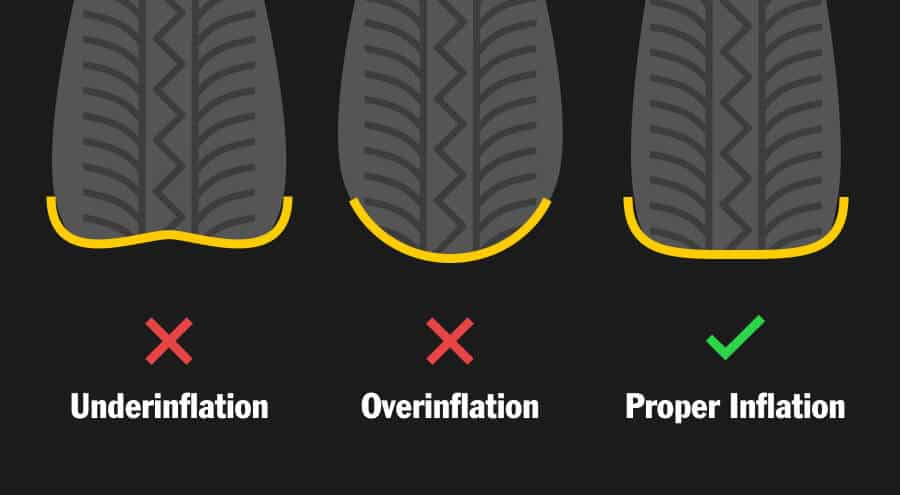
Accelerated center tread wear. Over-inflation causes the tire crown to bulge outward, shrinking the contact patch. The tire now bears most of its load on the center band of tread, which wears down faster than the edges. You’ll need new tires sooner than expected.
Reduced grip and harsh ride. A smaller contact patch means less traction, especially during cornering and wet-weather braking. The sidewall loses its ability to flex and absorb bumps, so every pothole and road seam transfers directly into the suspension.
Higher blowout risk. An over-inflated tire is already under maximum structural stress. When it hits a pothole or sharp object, it has no give — the sudden impact can cause an instant failure. Under-inflated tires generate heat and fail gradually; over-inflated tires can fail suddenly and without warning.
The correct pressure for daily driving is the placard PSI, full stop. The sidewall number is a safety rating, not a target.
Risks of Underinflation
Underinflation is the more common problem, and it’s equally serious in different ways.
When a tire runs below its recommended pressure, the sidewall flexes more than it’s designed to. That flexing generates heat inside the tire — and heat is the primary driver of tread separation and catastrophic blowouts. Underinflated tires also have an enlarged contact patch, which increases rolling resistance and forces the engine to work harder, reducing fuel efficiency noticeably over time.
Handling also degrades. Steering feels vague, braking distances increase, and the risk of hydroplaning in wet conditions rises. Edge wear on the tire shoulders — the telltale sign of chronic underinflation — shows up over time, signaling that the tires weren’t consistently maintained at proper pressure.
Impact of Incorrect Pressure at a Glance
| Condition | Safety Risks | Performance & Wear |
|---|---|---|
| Underinflation | Overheating, blowout risk, longer braking, hydroplaning | Shoulder wear, lower fuel economy |
| Overinflation | Impact blowouts, reduced traction, compromised ABS | Center tread wear, harsh ride, stress on suspension |
How to Reset the TPMS on Your Honda Civic (10th & 11th Gen)
Modern Civic models use an indirect TPMS rather than individual pressure sensors in each wheel. Instead of reading actual PSI, the system monitors wheel rotation speed through the ABS sensors. If a tire loses pressure, its diameter shrinks and it rotates faster relative to the others — when that difference exceeds the system’s threshold, the warning light triggers.
Because this system measures relative change from a calibrated baseline, you must reset (calibrate) it after every pressure adjustment, tire rotation, or new tire installation. If you adjust the pressure and skip the reset, the warning light stays on even if all four tires are perfectly inflated.
Reset procedure — Lower trims (LX and models with physical buttons):
- Make sure all four tires are at the correct cold PSI
- Find the TPMS reset button on the dashboard panel to the left of the steering wheel
- Press and hold the button for approximately five seconds
- The warning light will blink twice and turn off, confirming the reset
Reset procedure — Higher trims (EX, Touring, models with Display Audio):
- Make sure all four tires are at the correct cold PSI
- From the home screen, go to Settings → Vehicle → TPMS Calibration → Calibrate
After either reset, drive the vehicle for a few miles — or approximately 30 minutes — to allow the system to fully learn the new baseline and complete calibration.
Don’t Forget the Spare Tire
If your Civic has a compact spare (the smaller “donut” spare), its pressure requirements are completely different from the regular tires.
Compact spares require 60 PSI (420 kPa) — nearly double what the road tires need. That high pressure is necessary to support the load on such a small wheel.
A few important rules when using the spare:
- Do not exceed 50 mph (80 km/h)
- Expect reduced traction and a noticeably firmer ride
- Get the original tire repaired or replaced as soon as possible — the spare is a short-term solution, not a long-term fix
Because the spare is almost never used, its pressure is also almost never checked. A spare sitting at 32 PSI instead of 60 PSI is critically underinflated and unsafe to use in an emergency. Check it monthly along with the other four tires.
Putting It All Together
Correct tire pressure for a Honda Civic isn’t complicated, but it does require consistency. Here’s the short version of everything above:
- Check the door placard first — the sticker on the driver’s side door jamb lists the exact cold PSI for your specific Civic.
- Measure when tires are cold — before driving, or after at least three hours of inactivity.
- Check monthly — don’t wait for the TPMS light. Also adjust when ambient temperatures shift significantly.
- Reset TPMS after every adjustment — use the physical button or the infotainment menu depending on your trim level.
- Ignore the sidewall number for daily driving — it’s a maximum safety rating, not a target.
That’s it. Five consistent habits that protect your tires, your fuel economy, your ride quality, and most importantly — your safety.
FAQ
What is the correct tire pressure for a 2025 Honda Civic? Most 2025 Civic Sedan and Hatchback models call for 33 PSI front and 32 PSI rear when measured cold. Always verify against the door placard, as it’s specific to your trim and tire size.
Can I inflate my Honda Civic tires to 40 PSI? No. Inflating to 40 PSI exceeds the manufacturer’s recommendation for standard Civic trims and can lead to center tread wear, reduced grip, and a higher risk of impact blowouts. Follow the door placard — typically 32–35 PSI.
Why does my Civic’s TPMS light come on in cold weather? Cold temperatures cause air to contract, which drops tire pressure by 1–2 PSI for every 10°F temperature decrease. Add air to restore the placard PSI and then perform a TPMS reset.
How often should I check tire pressure on my Honda Civic? At least once a month and before any long trip. Also check whenever there’s a significant shift in seasonal temperatures.
What PSI does the compact spare need on a Honda Civic? The compact spare requires 60 PSI (420 kPa) — significantly higher than the road tires. Check its pressure monthly even if you’ve never needed to use it.
Does tire pressure affect fuel economy? Yes. Underinflated tires increase rolling resistance, forcing the engine to work harder and reducing miles per gallon noticeably over time. Keeping tires at the correct PSI is one of the simplest ways to maintain fuel efficiency.